

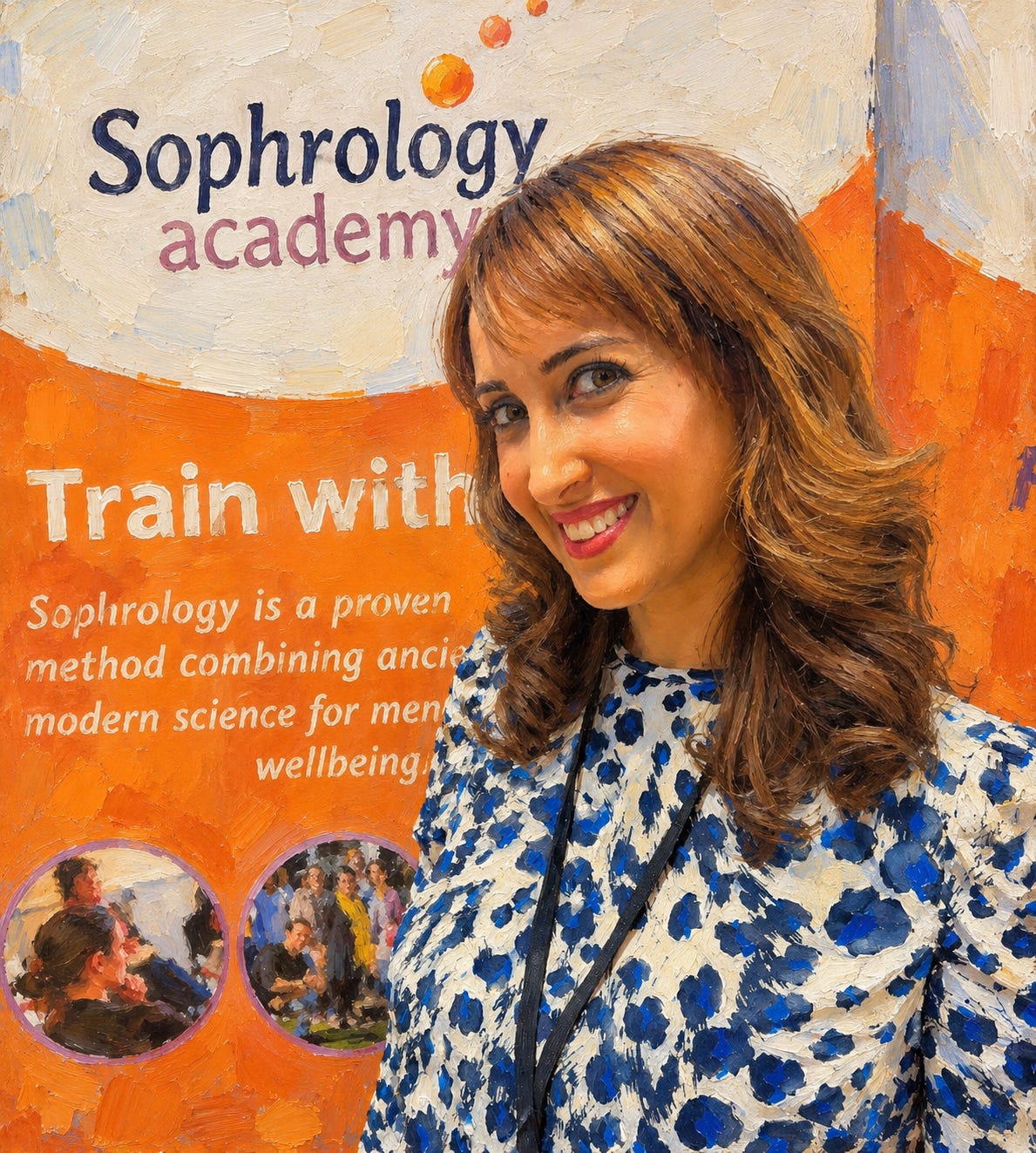
This month, I added another qualification to my credentials.
But this one feels different.
I am now a qualified Sophrologist, having graduated with distinction from the Sophrology Academy in the UK.
At first glance, Sophrology might seem far removed from molecular genetics, nutrition and the Developmental Origins of Health and Disease (DOHaD), which have shaped much of my work.
Increasingly, I see the opposite.
Sophrology has given me another way to explore the question at the heart of The Womb Effect®:
How early can we begin creating health?
When we move the starting point of health backwards from disease to childhood, from childhood to infancy, from infancy to pregnancy, and from pregnancy to preconception, we eventually arrive at the people who will become parents.
Their health and wellbeing matter.
Not only what they eat, how they move or what they are exposed to, but also how they sleep, experience stress, navigate relationships and respond to the world around them.
Through the lens of epigenetics, we now know these psychological experiences don’t just affect the parents’ mood; they leave biological markers that echo into the next generation.
More than a century ago, the psychologist and philosopher William James wrote:
“My experience is what I agree to attend to.”
Attention does not give us unlimited control over our circumstances or biology. But our capacity to notice what is happening within and around us and to work with our responses may itself be part of health.
If we want to talk seriously about creating healthier beginnings, the psyche must be part of the conversation.
The mind does not stay in the mind
Medicine has become adept at dividing the human organism into systems: cardiovascular, endocrine, neurological, immune, reproductive and psychological.
These divisions are useful in research and clinical practice; biology itself is less tidy.
A psychological experience does not remain confined to what we call “the mind”.
When we perceive a threat, the brain coordinates responses through the autonomic nervous system and the hypothalamic-pituitary-adrenal axis. Heart rate may change. Cortisol and other stress mediators fluctuate. Sleep, appetite, behaviour, immune signalling and inflammatory processes may all be affected.
Communication also travels in the opposite direction. Bodily states can influence the brain, mood, attention and behaviour.
This is not a new-age claim. It is physiology.
The nervous, endocrine, immune and metabolic systems are in continuous conversation with one another and with our behaviour.
Practices that combine breathing, movement, relaxation, attention, and bodily awareness may offer practical ways to engage with parts of that conversation.
That curiosity led me to Sophrology.
What is Sophrology?
Most people I meet have never heard of it.
Sophrology was developed in the 1960s by Professor Alfonso Caycedo, a Colombian-born neuropsychiatrist working in Madrid. He was interested in consciousness and in developing methods that could support people experiencing psychiatric and neurological difficulties.
The name itself reflects this ambition.
It derives from Greek roots: “sos,” meaning " harmony”“ or balance; “phren,” meaning "consciousness " or mind; and “logos,” meaning "study " or discourse.
Therefore, Sophrology can be broadly defined as the study of consciousness in harmony.
Caycedo's medical training exposed him to Western psychiatry, phenomenology, hypnosis, and relaxation methods. His later encounters with yoga, Buddhist meditation and Japanese Zen also influenced the development of his approach.
Sophrology gradually evolved into a structured practice combining:
Breathing. Relaxation. Gentle movement. Body awareness. Concentration. Visualisation. Usually performed in a structured sequence.
The person remains awake and actively engaged throughout.
Sophrology is not hypnosis. Although it shares elements with meditation and other contemplative practices, it is not simply another term for meditation.
It is a structured mind-body method intended to enhance awareness of bodily sensations, thoughts and experiences while cultivating the capacity for conscious regulation.
That immediately piqued my interest as a scientist.
“Consciousness is conquered.”
An ancient question approached from different directions
Sophrology is not my first encounter with mind-body practice.
I am also a certified Qigong practitioner and have practised Qigong for many years.
Qigong comes from a distinct intellectual and historical tradition rooted in Chinese practices that combine posture, movement, breathing, attention and bodily cultivation.
Qigong and Sophrology are not synonymous. Their histories, philosophies and conceptual frameworks should not be collapsed into one another.
What interests me is where they converge.
Across cultures and centuries, people have repeatedly developed methods that bring together breath, movement, attention, and bodily awareness to influence mental states.
Modern research is beginning to examine processes that may help explain why these practices matter.
We see this in how breathing directly modulates autonomic activity, how movement alters metabolism and circulation, and how sleep and stress intimately interact with our endocrine and immune pathways.
Mind-body interventions, including meditation, yoga, breathing practices and relaxation techniques, are increasingly being studied for their potential effects on stress, anxiety, sleep and aspects of physiological health.
The evidence is not equally strong for every intervention or every claim.
Sophrology, in this regard, presents a unique advantage: it is remarkably adaptable, allowing for practice at any time and in any setting. Whether one is standing, seated, or lying down, indoors or outdoors, it does not necessitate silence, stillness, a mat, or proximity to nature.
After just a few sessions, it empowers individuals to regulate their responses and build positive resilience, no matter what life presents.
Why I chose formal training
I could have continued exploring these methods through personal practice.
But if I was going to integrate mind-body work into my professional thinking, I wanted to understand it properly.
I wanted to study its theory, origins, principles, practical applications and limitations. I wanted supervised practice and experience guiding others, rather than only practising the techniques myself.
That led me to the Sophrology Academy in the UK.
The training went far beyond learning relaxation exercises. It included theory, structured practice, case studies, internship groups and the discipline of learning how to guide another person responsibly.
I am proud to have completed that journey. Yet the most valuable outcome is a wider understanding of health.
Where Sophrology meets The Womb Effect®
When we discuss preparing for pregnancy or supporting new parents, the conversation can easily become a checklist:
Nutrition. Folic acid. Exercise. Sleep. Avoiding harmful exposures. Managing existing health conditions.
While all these aspects are undoubtedly important, The Womb Effect® has asked a broader question:
What are the biological, psychological and environmental conditions surrounding the beginning of life, and how much earlier can we begin supporting them?
Once we ask that, the boundaries of prevention widen.
Fertility, pregnancy, birth and early parenthood can bring uncertainty, fear, physical change, disrupted identity and profound responsibility. These experiences affect mothers, fathers, partners and co-parents. Their wellbeing also shapes the family environment.
Simply telling someone to “reduce stress” is rarely useful.
Sophrology offers something more practical: a structured way to practise breathing, movement, relaxation, attention and bodily awareness.
It does not remove difficult circumstances, guarantee pregnancy outcomes or replace appropriate medical or psychological care.
But it may offer people practical tools for meeting those circumstances differently.
Science helps us understand why biological, psychological and environmental conditions matter.
Sophrology gives me one practical way to begin working within them.
Moving the starting line backwards
The Womb Effect® is built around a simple idea:
Too often, when it comes to health, we begin too late.
We intervene after disease develops.
We think about a child’s health after birth.
We begin preparing for pregnancy once pregnancy has already begun.
And sometimes we offer people coping tools only after they are already overwhelmed.
What happens if we move that starting line backwards?
What if mind-body skills were developed before they were urgently needed?
A personal thank you
No qualification like this is earned alone.
My deepest thanks go to Florence Parot and Liz Murphy; to my teacher and mentor, Audrey Zannese; and to all my teachers at the Sophrology Academy for their knowledge, patience, generosity, and guidance throughout my training.
To everyone at the Academy, thank you for creating the environment in which that learning could happen.
And to the fellow Sophrologists and colleagues with whom I studied, practised, questioned, laughed and learned: thank you for being part of this journey.
I am proud of what this milestone represents.
But more than anything, I am excited about what comes next.
Because healthy beginnings today create healthier generations tomorrow